CTRAN/W is a finite element CAD software product that can be used to
model the movement of contaminants through porous materials such
as soil and rock. The comprehensive formulation of CTRAN/W makes
it possible to analyze problems varying from simple particle tracking
in response to the movement of water, to complex processes involving
diffusion, dispersion, adsorption, radioactive decay and density
dependencies. CTRAN/W can be applied to the analysis and design of
geotechnical, civil, hydrogeological, and mining engineering projects.
CTRAN/W is designed to be used in tandem with a seepage analysis such as
SEEP/W to analyze
contaminant transport.
SEEP/W computes
the water flow velocity, volumetric water content, and water flux;
CTRAN/W uses these parameters to compute the contaminant migration.
Easy to Use
Defining a Contaminant Transport Model
Once you have solved your flow problem with
SEEP/W or
VADOSE/W,
you can use the graphical tools in CTRAN/W to interactively apply
boundary conditions and specify material properties. Conduct a
simple particle tracking analysis, or define dispersivity,
diffusion, adsorption, decay and density to conduct an
advection-dispersion analysis.
Viewing the Analysis Results
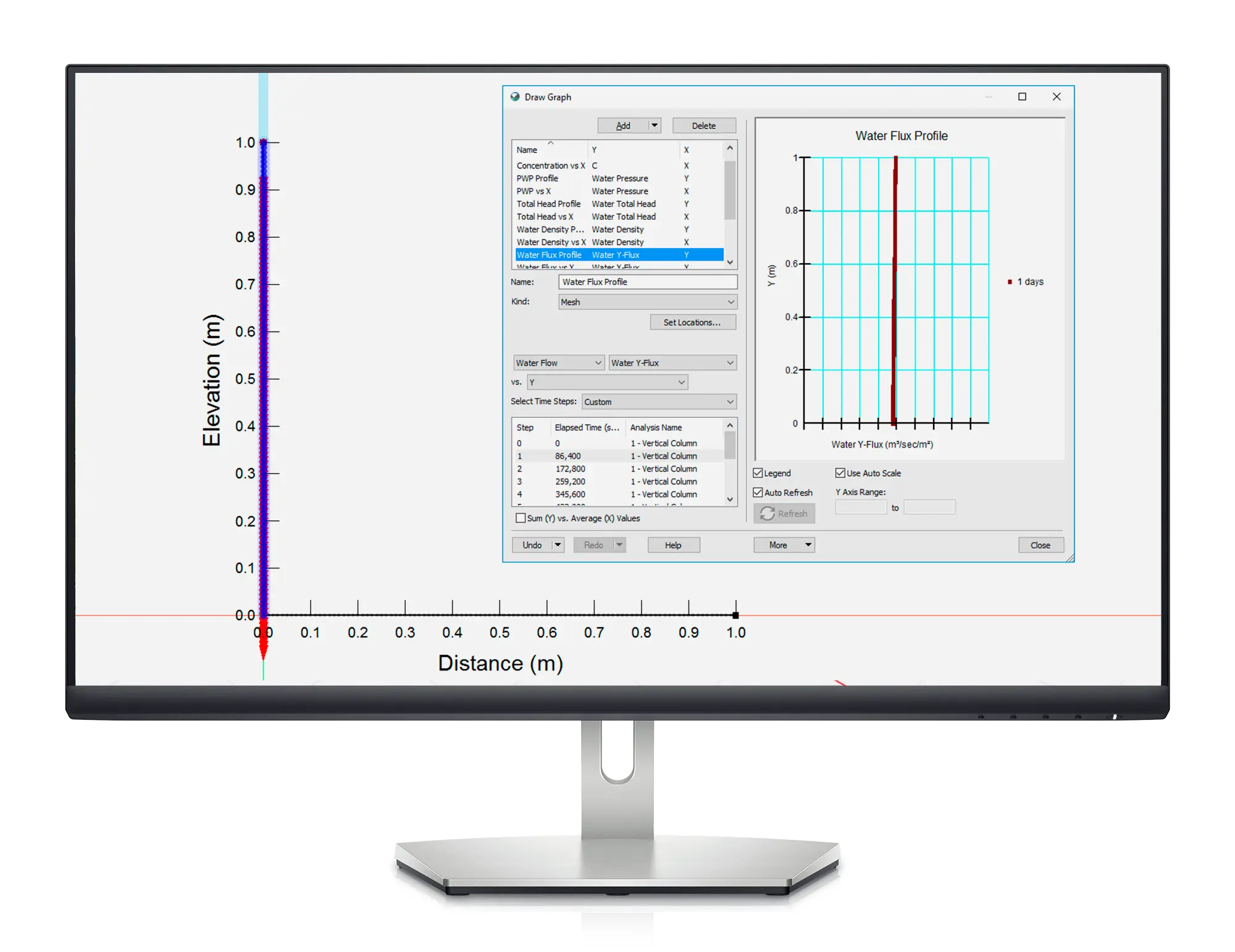
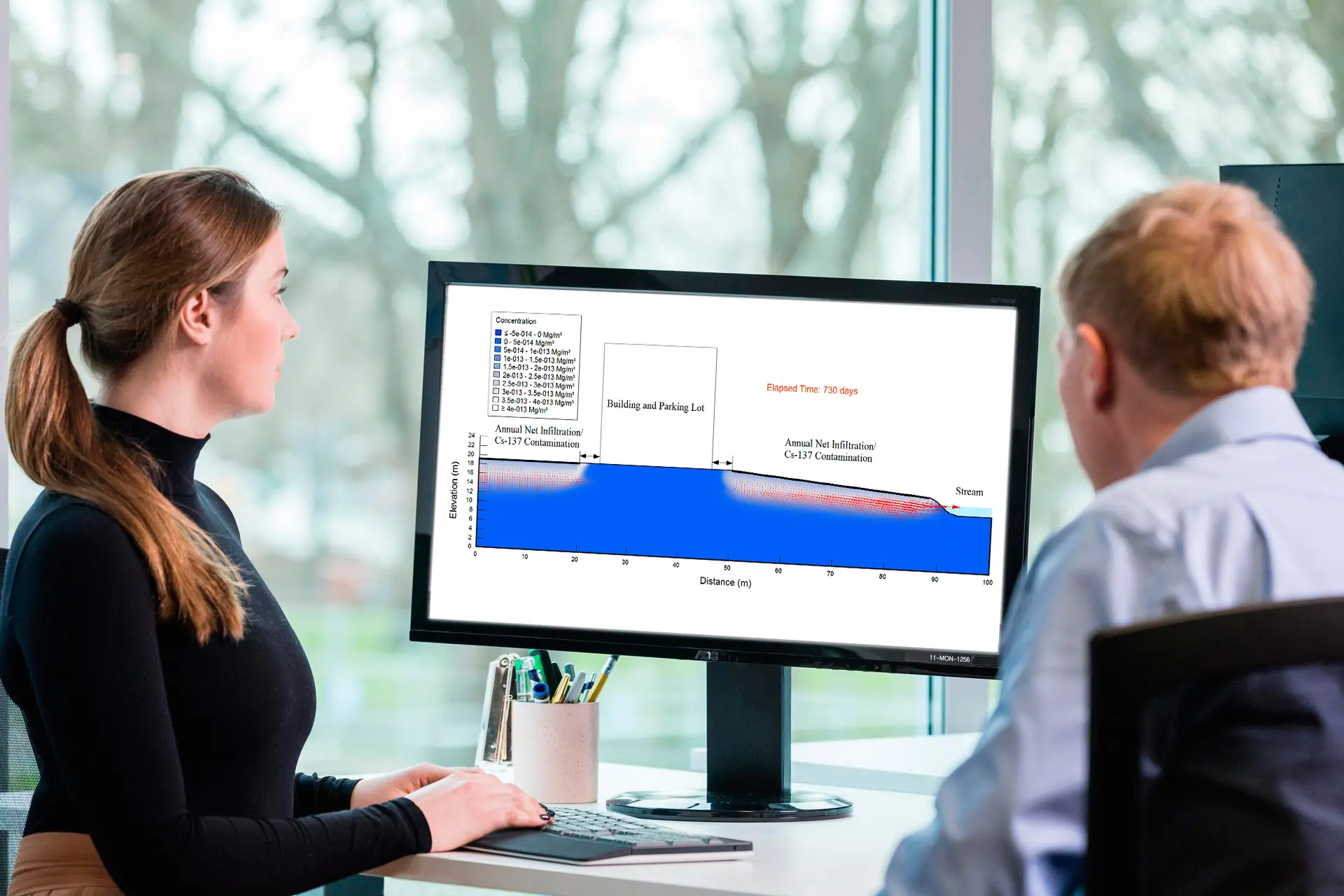
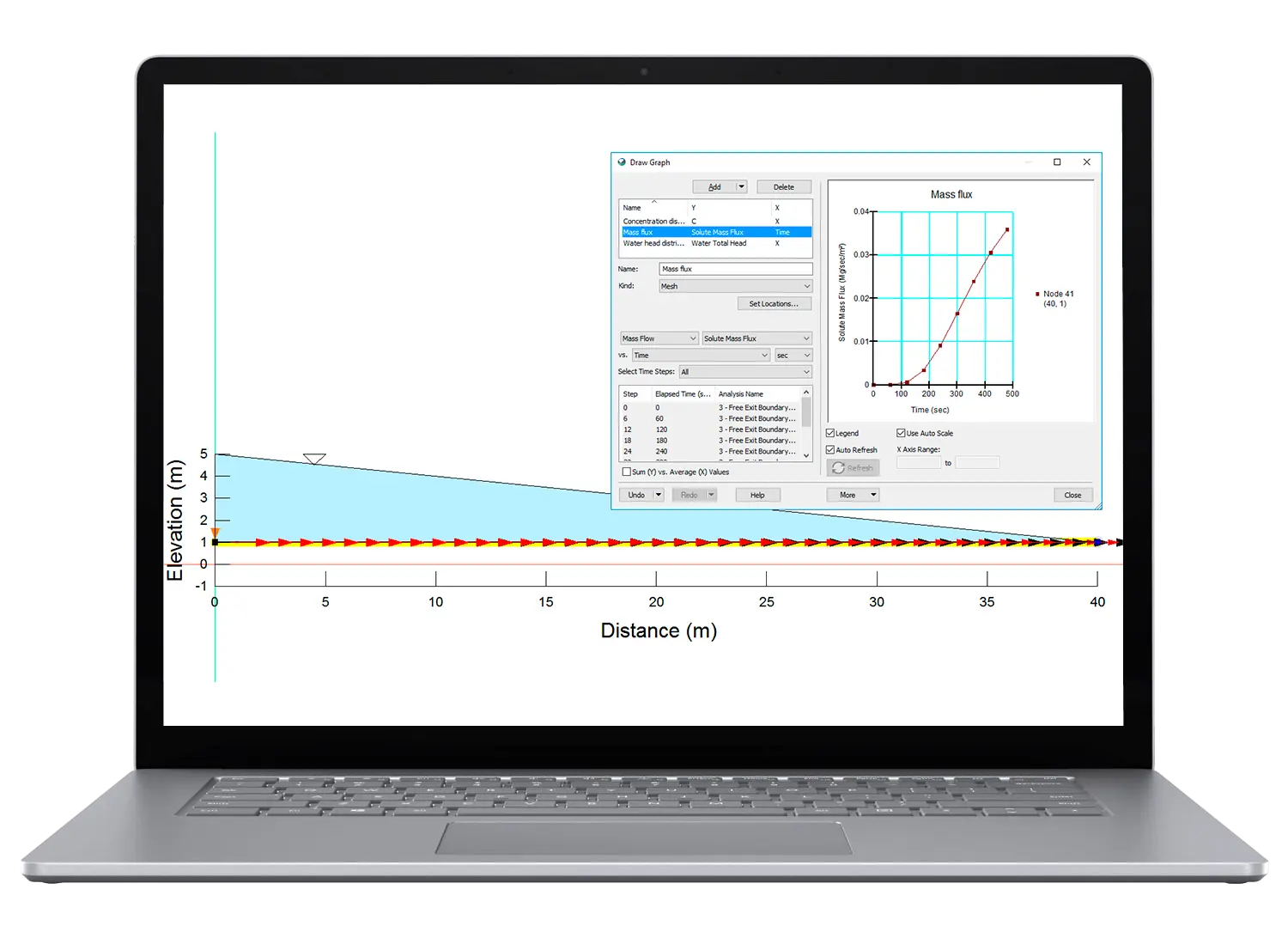
After solving your contaminant transport problem, CTRAN/W
offers many tools for viewing results. Generate contours or x-y
plots of any computed parameter, such as concentration, mass,
adsorption, dispersion, or Peclet and Courant numbers. Velocity
vectors show the flow direction and rate. Examine the contaminant
mass in the solid and liquid phases at any location. Transient
conditions can be shown by plotting the changing concentration
levels over time. Interactively query computed values by clicking
on any node, element Gauss region, or flux section.
Then prepare the results for your report by adding labels, axes,
and pictures, or export the results into other applications such as
Microsoft® Excel® for further analysis.
Typical Applications
CTRAN/W can model almost any contaminant transport problem, including:
- Flow of contaminants from a surface pond
- Flow of dissolved hydrocarbons
- Flow of radioactive contaminants
- Transport through fractured rock
- Sea-water intrusion into coastal aquifers
- Brine transport
- Landfill leachate migration
- plus many more!
* Microsoft, Windows and Excel are trademarks or registered trademarks of Microsoft Corporation in the United States and/or other countries.